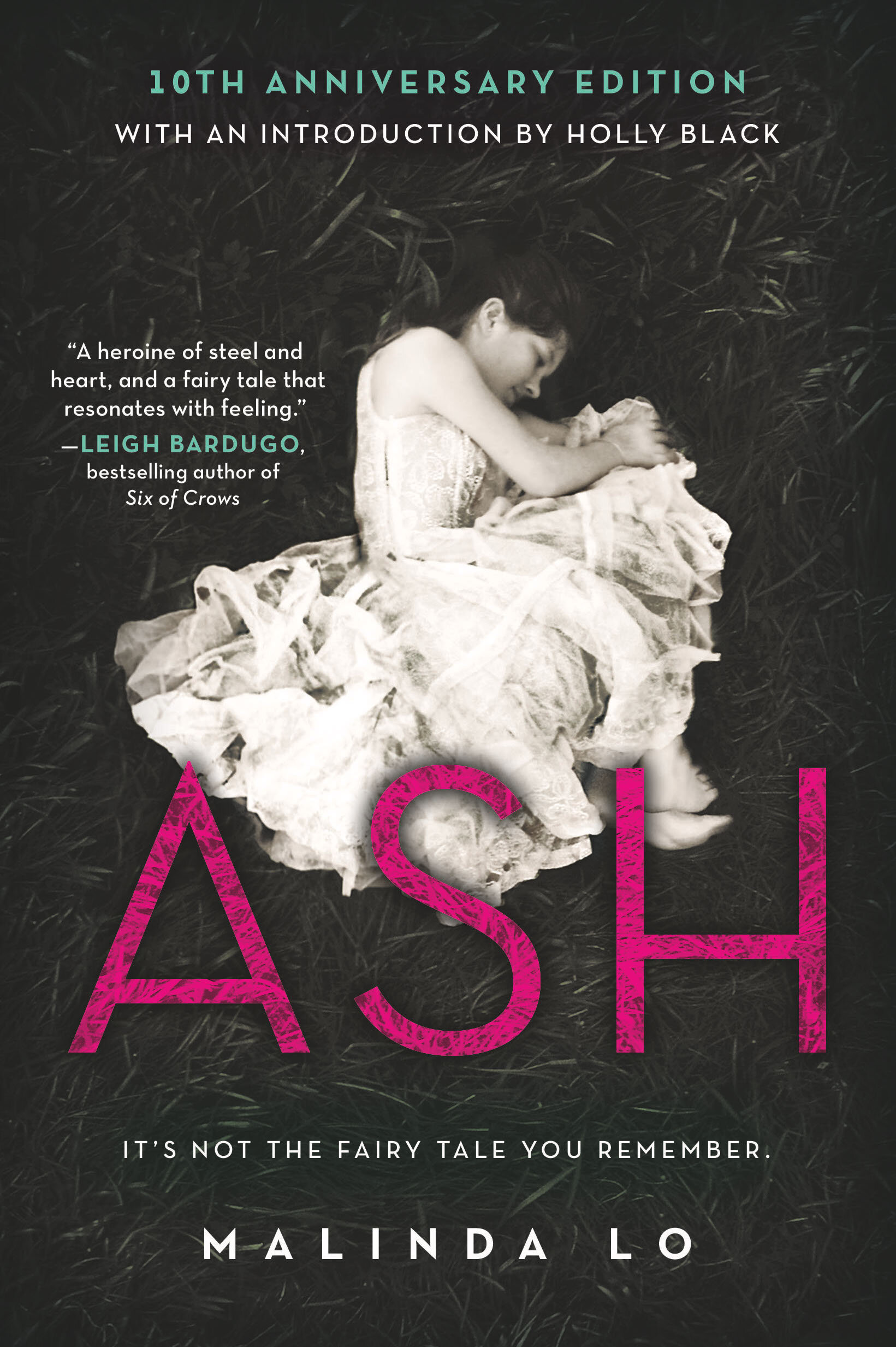
For the past month I have been working on yet another major rewrite of Ash (hopefully the last big one!), and I just finished a feverish week of writing till midnight (midnight!) and drinking Diet Coke and not seeing any real people (OK, I saw them, but I didn’t talk to them!), and today I sent it off to my editor and I am free! Free! Until I have to do another round of editing, but hey, I’m not thinking about that right now.
Frankly, although I love my book dearly and feel quite friendly toward it right now, I also feel kinda dazed. I can relate to Libba Bray.
It’s funny, but when I get in deadline mode, I become extremely productive and am able to not only complete my project on time, but also read entire books for pleasure (I finished and loved Robin McKinley’s Chalice, which I’ll write more about next week, and am halfway through Shannon Hale’s Austenland), watch lots of TV (I haven’t missed an episode of Project Runway or Survivor), and become extremely well-informed about current events (anybody wanna discuss the Wachovia-Wells Fargo-Citigroup fiasco?). I don’t know why I can do this, but I’m pretty sure it’s how I survived grad school.
Anyway, the good thing about this is that I have also been able to do a lot of web surfing, which as managing editor of AfterEllen.com I just didn’t do. Back then I mostly went to the sites I knew would give me the info I needed right away, and the rest of the time I stayed the hell away from the internet. Now, though, I am addicted to it. I swear, it was almost crushing my ability to get any writing done! Good thing I’m also kind of a strict disciplinarian (hee).
So, that is how I found Libba Bray’s blog (she is the author of A Great and Terrible Beauty). It has become a huge comfort to me to know that there are other writers out there also pounding away at the keys. There are some writers whose blogs I read every day, like Robin McKinley, who has now launched her own forum (which, I admit, freaks me out a bit because, OMG, interacting with Robin McKinley fans in a free-wheeling discussion!). And there are some writers’ blogs I’ve only recently stumbled across, like that of Kristin Cashore, author of Graceling, which is getting a lot of positive reviews and sounds so interesting I think I’m going to go out and buy it today. Seriously.
I really enjoy Shannon Hale’s blog, too, because it’s called Squeetus for some reason, and because she writes very well-thought-out posts on reading, author responsiblity and more. (Hale wrote Goose Girl as well as the aforementioned Austenland). I also came across Jennifer Weiner’s blog, where she is revising her 2002 advice for writers, which I think is really excellent. (Weiner has written lots of bestselling chick lit — and hey, I like chick lit too.) That might be because I think I pretty much inadvertently did everything in that list in that order, with the exception of getting a dog (I got the dog after I finished the book).
Last but not least, at a particularly bad moment during this rewrite when I thought for sure I was going to pull my hair out with frustration because I could not figure out how to get the main character from Point A to Point B without it being completely boring, I went to Laurie R. King’s blog and discovered that she had recently done a podcast interview on the revision process. Go here to download it. It totally saved me.
Next week, I get to start thinking in a focused way about book no. 2. I can’t wait! But first, I’m taking the weekend off. Woohoo!
Tags: Ash · Books · Writing
Today AfterEllen.com published a retrospective on lesbian poetry highlighting ten lesbian/bisexual poets, beginning (of course) with Sappho. My favorite poet overall, lesbian, bisexual or straight, is Edna St. Vincent Millay. Millay was known for her many lovers, some of them female, but I first heard of her when my grandmother gave me a book of Millay’s collected poems in 1991, when I was 17 years old. What a time to start reading Millay!
Many people love her for her lyrical verses that give off a feeling of youthful recklessness (especially “First Fig”: “My candle burns at both ends;/It will not last the night”). I certainly love those poems, but my favorite Millay poem has always been a somewhat somber poem titled “Childhood Is the Kingdom Where Nobody Dies.”
This week I am completing yet another major revision of Ash. I feel a bit like I’m in final exams period; I’ve even bought myself ice cream and Chinese takeout so that I don’t have to leave my work. The whole story of Cinderella begins when a child’s mother — and then her father — dies. It seems somewhat appropriate, then, that I remember this favorite poem of mine. I’m not sure what it says about me, but I still love it.
Childhood Is the Kingdom Where Nobody Dies
by Edna St. Vincent Millay
Childhood is not from birth to a certain age and at a certain age
The child is grown, and puts away childish things.
Childhood is the kingdom where nobody dies.
Nobody that matters, that is. Distant relatives of course
Die, whom one never has seen or has seen for an hour,
And they gave one candy in a pink-and-green stripéd bag, or a
jack-knife,
And went away, and cannot really be said to have lived at all.
And cats die. They lie on the floor and lash their tails,
And their reticent fur is suddenly all in motion
With fleas that one never knew were there,
Polished and brown, knowing all there is to know,
Trekking off into the living world.
You fetch a shoe-box, but it’s much too small, because she won’t
curl up now:
So you find a bigger box, and bury her in the yard, and weep.
But you do not wake up a month from then, two months
A year from then, two years, in the middle of the night
And weep, with your knuckles in your mouth, and say Oh, God!
Oh, God!
Childhood is the kingdom where nobody dies that matters,
—mothers and fathers don’t die.
And if you have said, “For heaven’s sake, must you always be
kissing a person?”
Or, “I do wish to gracious you’d stop tapping on the window with
your thimble!”
Tomorrow, or even the day after tomorrow if you’re busy having
fun,
Is plenty of time to say, “I’m sorry, mother.”
To be grown up is to sit at the table with people who have died,
who neither listen nor speak;
Who do not drink their tea, though they always said
Tea was such a comfort.
Run down into the cellar and bring up the last jar of raspberries;
they are not tempted.
Flatter them, ask them what was it they said exactly
That time, to the bishop, or to the overseer, or to Mrs. Mason;
They are not taken in.
Shout at them, get red in the face, rise,
Drag them up out of their chairs by their stiff shoulders and shake
them and yell at them;
They are not startled, they are not even embarrassed; they slide
back into their chairs.
Your tea is cold now.
You drink it standing up,
And leave the house.
Tags: Writing
True confession time: I am fascinated by agriculture. I believe this began when I first read Laura Ingalls Wilder’s Farmer Boy as a kid. Sure, everybody loves Little House on the Prairie etc., but my favorite of her books was her mouth-watering depiction of Almanzo Wilder’s childhood on a farm. The food in that book was intense. I remember fondly the scene in which Almanzo and his family go out digging potatoes, and of course it’s freezing outside and hard work, but what sticks with me? They roasted the potatoes in some kind of underground pit (I can’t remember exactly) and they eat them, all hot and mealy (I think this was the first time I encountered the word mealy), nearly burning their fingers. Yum.
Obviously, Farmer Boy was something of a fantasy, but hey, it created a lifelong and growing fascination with farming, recently stoked by Barbara Kingsolver’s excellent memoir/sustainable eco-farming manifesto, Animal, Vegetable, Miracle: A Year of Food Life.
Given my fascination with agriculture and the fact that I live in Northern California, where there’s an agricultural festival practically every month, I like to go to county fairs. This past weekend I went to the Sonoma County Harvest Fair (not to be confused with the bigger Sonoma County Fair held in August), where I witnessed many a wondrous thing, beginning with these giant pumpkins.

That was closely followed by a rainbow display of beautiful local apples.

It’s not all food at the Sonoma County Harvest Fair, though. There are also animals. Among the more fascinating of these creatures are the pgymy goats, which are paraded around by children and adults in some kind of beauty pageant.

Even cooler, though, are the sheepdog trials. This is where sheepdogs have to herd a trio of baa-ing sheep through a series of gates and narrow chutes into a pen. [Read more →]
Tags: Life · Books
To the surprise of no one, Sen. Joe Biden turned out to be more knowledgeable than Gov. Sarah Palin in Thursday night’s vice presidential debate, while Sarah Palin turned on her populist charm. What surprised me? The gay marriage question (transcript from CNN).
GWEN IFILL: Let’s try to avoid nuance, Senator. Do you support gay marriage?
JOE BIDEN: No. Barack Obama nor I support redefining from a civil side what constitutes marriage. We do not support that. That is basically the decision to be able to be able to be left to faiths and people who practice their faiths the determination what you call it.
The bottom line though is, and I’m glad to hear the governor, I take her at her word, obviously, that she think there should be no civil rights distinction, none whatsoever, between a committed gay couple and a committed heterosexual couple. If that’s the case, we really don’t have a difference.
GWEN IFILL: Is that what you said?
SARAH PALIN: Your question to him was whether he supported gay marriage and my answer is the same as his and it is that I do not.
And after Palin’s remark, everybody laughed.
Let’s take a moment here. Joe Biden and Barack Obama agree with Sarah Palin and John McCain about how they do not support same-sex marriage. OK, I’m not an idiot. I know that nobody who is a serious contender for president is going to support same-sex marriage. But tonight I realized that this is freaking insane. Here we have the people who want to be the leaders of our country agreeing to discriminate against gay people. Well, thank God that we can all agree on something these days (that was sarcasm).
You know what else is wrong with this picture? I’m pretty sure that Obama and Biden personally support their gay friends who want to get married. I think there’s a possibility that John McCain does, too. (I believe Sarah Palin when she says she doesn’t support gay marriage.)
You know what a person is called when he says one thing but believes another? Hypocrite.
I’m not saying that there aren’t serious issues at stake in this election including, obviously, the war in Iraq and the financial meltdown on Wall Street. And I know that cultural change comes slowly. But it disgusts me that politicians asking for our votes openly invite us to support their hypocrisy and publicly express their homophobia.
Tags: Politics
October 1st, 2008 · 1 Comment
This week is the American Library Association’s annual Banned Books Week, which has been observed since 1982 and "reminds Americans not to take this precious democratic freedom for granted." Among the 10 most frequently challenged books of 2007 is Philip Pullman’s The Golden Compass, for its "religious viewpoint."
Pullman recently wrote (via Read Roger) with glee that "The inevitable result of trying to ban something – book, film, play, pop song, whatever – is that far more people want to get hold of it than would ever have done if it were left alone. Why don’t the censors realise this?"

Personally, I loved The Golden Compass so much that I’ve read it twice. And you should, too. Forget about the movie version; just go and get yourself the actual book.
What other books were most frequently challenged last year? Well, a lot of them have to do with sex, although the number one most challenged book is about penguins. Same-sex penguins. Who wanted a baby penguin so badly they tried to hatch a rock that looked like an egg. When zookeepers discovered this, they gave the penguin couple (two males) a real penguin egg, and they hatched and raised it successfully.

Did I mention this is based on the true story of two real penguins in the Central Park Zoo? Well, it was challenged for the following bizarre reasons: Anti-Ethnic, Sexism, Homosexuality, Anti-Family, Religious Viewpoint, Unsuited to Age Group.
Yes, some people are so homophobic that the true story of two penguins becoming foster parents freaks them out. The world is a scary, sad place.
Other books often challenged include Mark Twain’s The Adventures of Huckleberry Finn ("racism"), Alice Walker’s The Color Purple ("Homosexuality, Sexually Explicit, Offensive Language") and Maya Angelou’s I Know Why the Caged Bird Sings ("Sexually Explicit").
Well, my book will include homosexuality as well as a really mean stepmother (anti-family?) and a relationship that might be deemed "unsuited to age group." Maybe my book will be banned! One can only hope.
Tags: Books
September 29th, 2008 · 1 Comment
In the last couple of weeks, I’ve been reading/watching/listening to more reports about the economy since I was an econ major in college. So maybe my OOTW should really be economics/the financial disaster/WTF with the bailout plan, but really, that’s not as sexy as Rachel Maddow.

One of the people I’ve been listening to as she wades through the morass of financial/political news is MSNBC’s latest anchorwoman, who also just happens to be an out lesbian and a former Rhodes Scholar and a ham, to boot. This week AfterEllen.com published their most recent interview with Rachel Maddow, and in the interview, well, Maddow is just awesome. Here are some of the things she says:
On being out:
"I think that there is a moral imperative to be out, and I think that if you’re not out, you have to come to an ethical understanding with yourself why you are not. And it shouldn’t be something that is excused lightly. I don’t think that people should be forced out of the closet, but I think that every gay person, sort of, ought to push themselves in that regard. Because it’s not just you. It’s for the community and it’s for the country.”
On sexism:
“One specific thing that I think has been interesting in this campaign is the use of ‘sexism’ and ‘sexist’ as an epithet in completely inappropriate ways. …
I think that young women are smart and I think that one of the things that young women have been very good at is calling people on their anti-feminist bulls–t. So I look to young women for leadership in terms of pointing out the difference between being a woman and being a feminist."
On being forced to wear makeup on TV:
“I feel like in terms of what I look like, I’m working in a very visual medium for the first time in my life, and I’m just sort of trying to get by in terms of the basic, the minimum that I need to do visually in order to be allowed to be on television. And so I put on the suit, so that I can go on TV. I let the makeup ladies put makeup on me, which they do to their own satisfaction. I don’t pay much attention to it.”
Another reason I can’t get enough? She is a total ham. Watch her facial expression as she dissects McCain’s performance in the first presidential debate last week:
OK, I admit that sometimes Maddow talks so quickly and I’m so mesmerized by trying to figure out how much makeup they’ve forced upon her (the feminization of butch women is something that deeply annoys me), that I lose track of what she is saying. But you know what? I have a DVR and it automatically records whatever I’m watching. I do not mind rewinding so that I can watch it again.
And that really says something.
Tags: Politics · Television · OOTW
September 29th, 2008 · 2 Comments
I recently read an essay by David Gessner in the New York Times Magazine’s college issue titled “Those Who Write, Teach.” Gessner is a creative writing professor who has also written six books, and in the essay he describes the experience of forgoing (mostly) the intensity of full-time writing for the more moderate life of academia. Although he makes sure to explain that he loves being a teacher, he still feels like teaching strips away some of the rawness of being a writer:
Even if we grant that you can be as original within the university as up in your garret, we must concede the possibility that something is lost by living a divided life. Intensity perhaps. The ability to focus hard and long on big, ambitious projects. A great writer, after all, must travel daily to a mental subcontinent, must rip into the work, experiencing the exertion of it, the anxiety of it and, once in a blue moon, the glory of it. It’s fine for writing teachers to talk in self-help jargon about how their lives require “balance” and “shifting gears” between teaching and writing, but below that civil language lurks the uncomfortable fact that the creation of literature requires a degree of monomania, and that it is, at least in part, an irrational enterprise.
I found myself reacting in a couple of different ways to his essay. I have a longstanding distrust of the stereotype of the writer as a tortured artist; I feel like it’s romanticizing to an unnecessary degree what is a lot of hard work. That stereotype also made my parents (and lots of other parents too) declare that being a writer was an unrealistic goal and a waste of my time.
And I hate it when people call me an “artist.” No, I say, I am not. I bristle at it. I don’t want to be associated with the idea of a moody, temperamental narcissist who relies on flashes of inspiration to create things that nobody without an advanced degree in semiotics can understand. And besides, I’ve been a “journalist” for several years now; I find my inspiration, I insist, in deadlines. (And honestly, I’ve never found a more effective antidote to writer’s block than a deadline.)
On the other hand, I admit that some of what Gessner wrote also resonated with me:
Before I became a professor, I managed to work full time as a writer, and I distinctly remember the experience of feeling angry right before I began turning fully to beginning a new book. Just who or what was I angry with? Anything or anyone who got in the way of my work. This may not have been a balanced way to be in the world, but in retrospect I can see what I was doing, and while my behavior wasn’t rational or “good,” it may have been necessary. I was clearing the ground — creating the life “with a broad margin” as Thoreau put it — to try something that would take all I had.
Yeah, I thought, I get that. When I get to the heart of what I’m writing, I have definitely cleared a wide path around me, divorcing myself from social obligations, household chores, etc., even closing the door on people I love because I don’t want to be disturbed. It makes me feel euphoric to be completely alone with my work. Euphoric. And generally speaking, I love going out and meeting people, so this is clearly a sign of some sort of mental disturbance.
The essay also got me to thinking about a conversation I had with a good friend of mine recently about her writing. She’s in a writers’ group that gets together regularly to critique each other’s work and to support each other, which I think is a wonderful thing. But she confessed to me that though she loves plotting out story lines and developing characters, she hates the act of writing. I said something to the effect of, “Yep, writing is hard.” And it is.
I am reminded of one of my favorite quotes about writing, from Gene Fowler (who, I learned through Wikipedia, was a journalist in the early 20th century who interviewed Buffalo Bill Cody):
“All you do is sit staring at a blank sheet of paper until drops of blood form on your forehead.”
That quote always cracks me up because it does perfectly evoke the feeling I’ve had of squeezing sentences out of my brain. And yet, even though writing is hard, I don’t think either Fowler or Gessner would say that they dislike writing. I think that writing is quite difficult, but at the same time, I love it. It’s something I have always done (although I hope my juvenilia never makes it into public) and have always loved.
And it makes me think: If you don’t love writing, the act of bringing all those story lines and characters into life, then it’s not worth the effort. A lot of people say they want to be writers, but they might love the idea of being a writer more than the actual act of writing. I think they love that idea because of the myth of the writer, alone in her garret, possessed by an incendiary thought, pouring words of genius onto paper. (This is followed by adoration from a legion of readers after publication, which grants the writer the right to become an eccentric recluse living in a house on a cliff by the sea.)
But it’s not like that. First you’ve got to sit there, in that chair, and squeeze out those words. Sometimes they come in a flood, sometimes they come in a trickle. And it does take, I suppose, a particular kind of personality to get any enjoyment out of that. If you’re not that kind of person, why subject yourself to the torture?
If what’s actually going on is a deeply rooted fear that those story lines and characters will never bloom on the page and you’re just going to ruin them and never be able to do it successfully, thereby making the act of writing akin to having your wisdom teeth pulled with no anesthesia, all I can say is: Jump in. You’ll never learn how to swim by staying on the shore.
Tags: Writing
September 25th, 2008 · No Comments
My latest Notes & Queeries column went up earlier this week at AfterEllen.com. It’s not often that I get to say this, but this article was inspired by a conversation with my mother, in which she mentioned picking up a copy of People magazine at Wal-Mart — the People that featured Ellen DeGeneres and Portia de Rossi getting married on the cover.

Thinking about Wal-Mart unexpectedly brought up some old memories about a childhood friend, as well as coming out. Even though Wal-Mart is pretty much universally despised by lefty liberals like me, I have to admit that I have a soft spot for the Wal-Mart in Lafayette, Colorado. (Read my column here.)
Tags: Notes & Queeries
September 24th, 2008 · 1 Comment
I’d like to introduce you all to the dog I share with my girlfriend. Her name* is 007. One of her favorite activities is searching for treasure.

* Not her real name.
Tags: 007 Speaks
September 23rd, 2008 · 3 Comments
A recent article in the Boston Globe notes that new, sanitized versions of traditional fairy tales (including a retelling of “Rapunzel” that accompanies a Rapunzel playset) are leaving out the most important elements: the frightening and violent parts.
After I got over the fact that someone had made a playset out of the tower in which a girl (Rapunzel) was imprisoned for years until a wandering man climbed up her hair to sleep with her — wait a sec, I don’t think I’ve gotten over that yet. I guess it makes sense that the book accompanying this toy would be a sanitized version, because what’s so fun about imprisonment?

The article’s author, Joanna Weiss, interviews Jack Zipes, a well-known fairy tale scholar, about the deeper meanings of traditional fairy tales and how they have changed in recent years. Weiss writes: “Zipes points out that many fairy tales become far more sanitized when they meet the children’s literature industry - which is increasingly dependent on sequels and product tie-ins, and calibrated to appeal to the lowest common denominator.”
I agree that the Disneyfication of fairy tales has led to an inordinate amount of pink princess costumes, but I’m not sure that the entire children’s literature industry is so callously stripping traditional fairy tales of their deeper, darker meaning. I don’t think the writer really believes this either, since she mentions Donna Jo Napoli’s complex retelling of “Rapunzel,” Zel. (Confession: I own the book, but I haven’t ever managed to read it.)
In fact, I think that fairy tale retellings — adventurous, complicated ones — are just as in vogue as ever, if not more. But simultaneously, there is a huge princess industry that publishers, movie studios and toy manufacturers are all deeply invested in. And to be honest, when I was a kid I wanted a princess costume, too. I didn’t know that Cinderella’s stepsisters cut off parts of their feet to fit them in the glass slipper until I was well past the Disney stage of my Cinderella obsession. And I don’t necessarily think that’s a bad thing.
The point is, I did ultimately find out that fairy tales are much more multilayered than Disney makes them. I’m sure that not every kid is going to, but times change. Fairy tales get retold in books like Harry Potter, as Weiss and Zipes note; movies like Star Wars reshape the old tradition of the heroic quest. The main problem is that there is so much out there these days, both good and bad. How do we wade through it all to find the gems? Because I think there are a lot of them.
Tags: Uncategorized